
Ultimate Java Interview Guide 2026: 100+ Questions, Answers & Concepts
1. The Architectural Foundation of Java
To understand Java, one must look beyond the syntax. Developed by James Gosling at Sun Microsystems in 1995, Java was designed with a specific goal: Platform Independence. In the mid-90s, software had to be recompiled for every operating system. Java disrupted this by introducing the Java Virtual Machine (JVM).
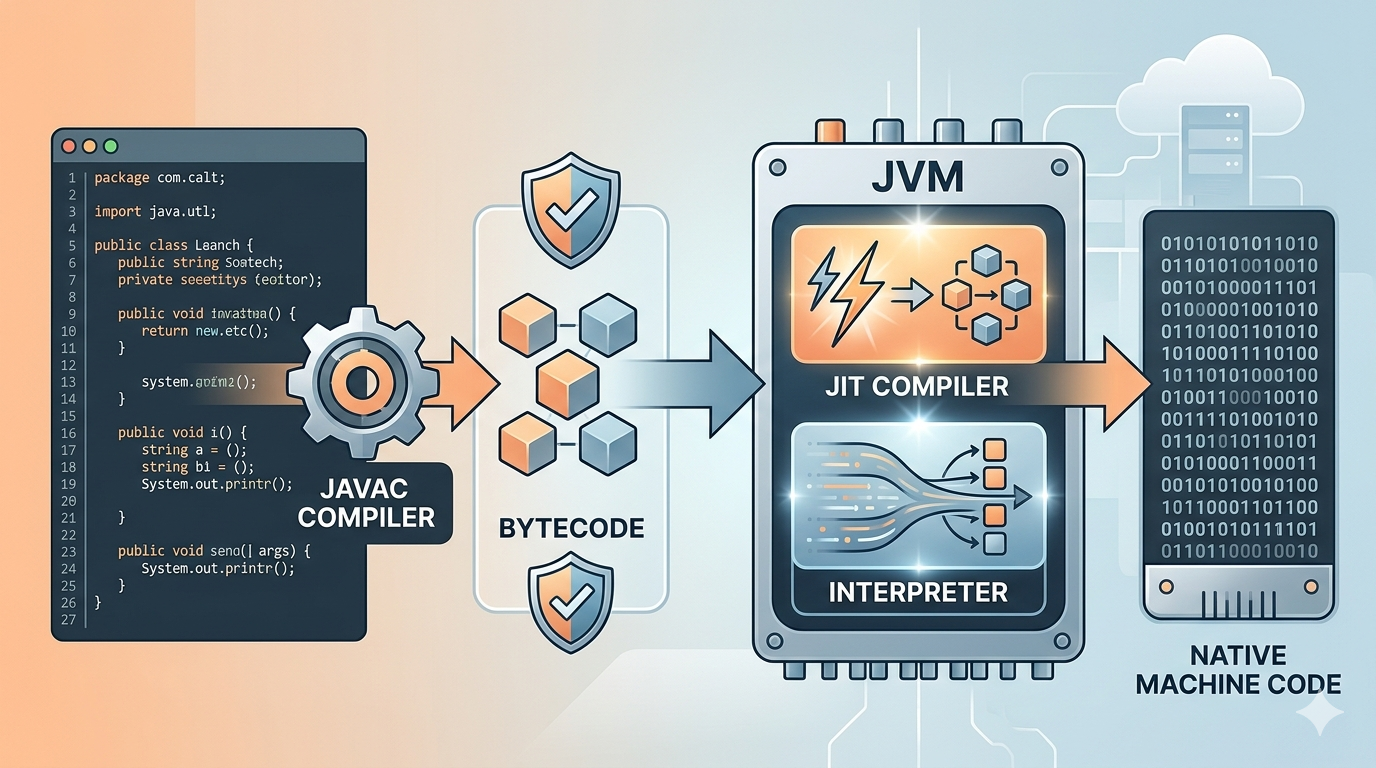
When we talk about Java being "Write Once, Run Anywhere" (WORA), we are referring to the Bytecode.
 Unlike C or C++, which compile directly into machine-specific machine code, Java compiles into an intermediate form. This bytecode is a highly optimized set of instructions that the JVM translates into native machine code at runtime. This unique architecture is why Java remains the #1 choice for enterprise systems, Android development, and big data processing in 2026.
Key Concept: The JIT Compiler
A common misconception is that Java is purely "interpreted." In reality, modern JVMs use a Just-In-Time (JIT) Compiler. It monitors which parts of your code are executed frequently (hotspots) and compiles them into native machine code to boost performance. This makes Java nearly as fast as C++ while maintaining the safety of a managed language.
2. Understanding the Execution Environment
In an interview, you might be asked to explain the relationship between the JDK, JRE, and JVM. Think of them as layers of an onion:
The JDK (Java Development Kit) is the outermost layer. It is the full toolbox. If you want to create a `.java` file and turn it into a `.class` file, you need the JDK. It includes the compiler (javac), documentation tools (Javadoc), and the debugger (jdb).
The JRE (Java Runtime Environment) is the middle layer. It is what you need to run a Java program but not necessarily develop one. It contains the class libraries (like `java.lang`, `java.util`) and the JVM itself.
The JVM (Java Virtual Machine) is the core engine. It handles:
• Loading code via the ClassLoader.
• Verifying code via the Bytecode Verifier (to ensure no malicious code bypasses security).
• Executing code via the Interpreter and JIT Compiler.
• Memory Management via the Garbage Collector.
3. Variables, Data Types, and the Memory Puzzle
Java is a Statically-Typed language. This means the type of every variable must be known at compile time. This provides a massive safety net, preventing the "Type Mismatch" errors common in languages like JavaScript or Python.
Primitive vs. Reference Types
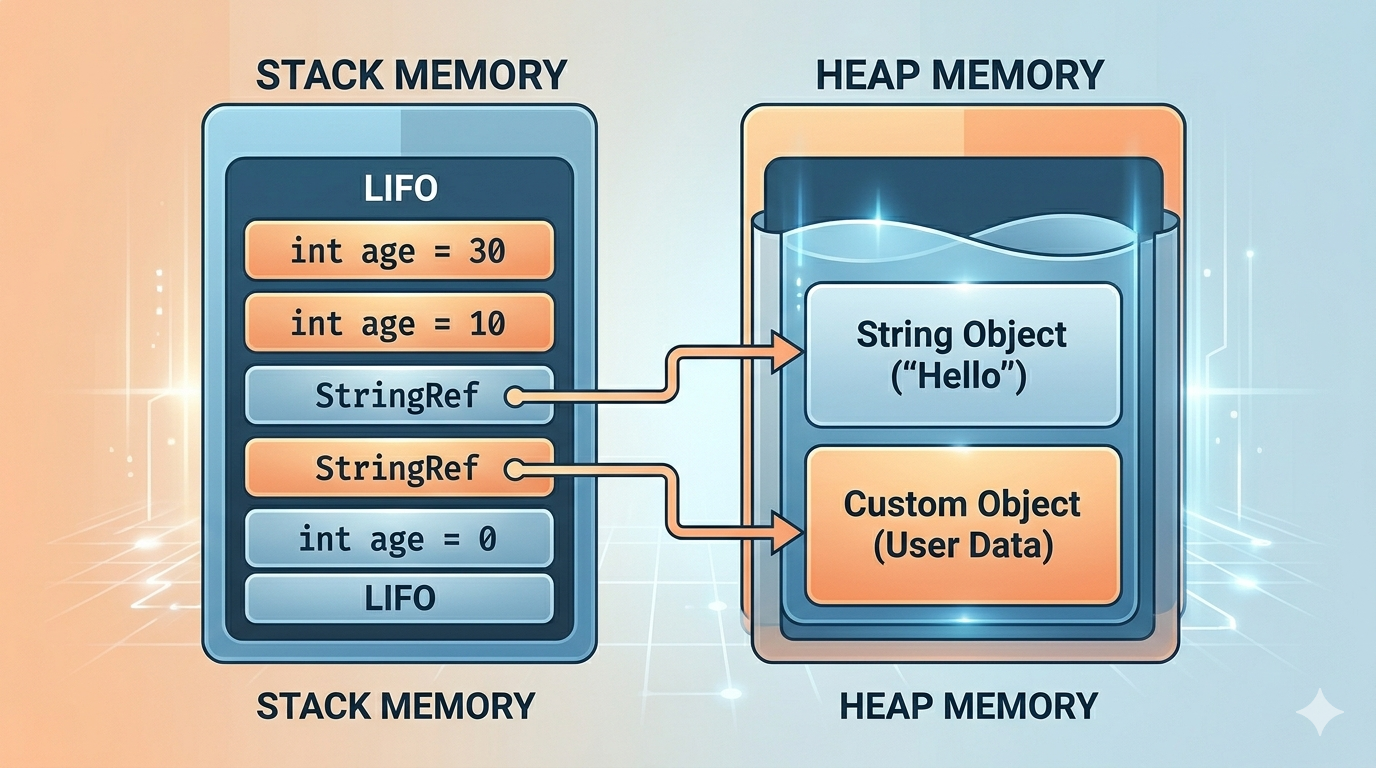
Java has 8 primitive types: `byte`, `short`, `int`, `long`, `float`, `double`, `boolean`, and `char`. These are stored directly in the Stack Memory because their size is fixed.
Conversely, Objects (like `String`, `Scanner`, or custom classes) are reference types. The reference (the address) is stored on the Stack, but the actual object data lives in the Heap Memory.
Unique Interview Insight: Why is 'char' 2 bytes in Java?
Most languages use ASCII (1 byte). Java uses Unicode (specifically UTF-16). This allows Java to represent characters from almost every language in the world, making it truly global.
4. Mastering the 4 Pillars of OOP
If you can't explain OOP, you can't pass a Java interview. But don't just give bookish definitions; explain the "Why".
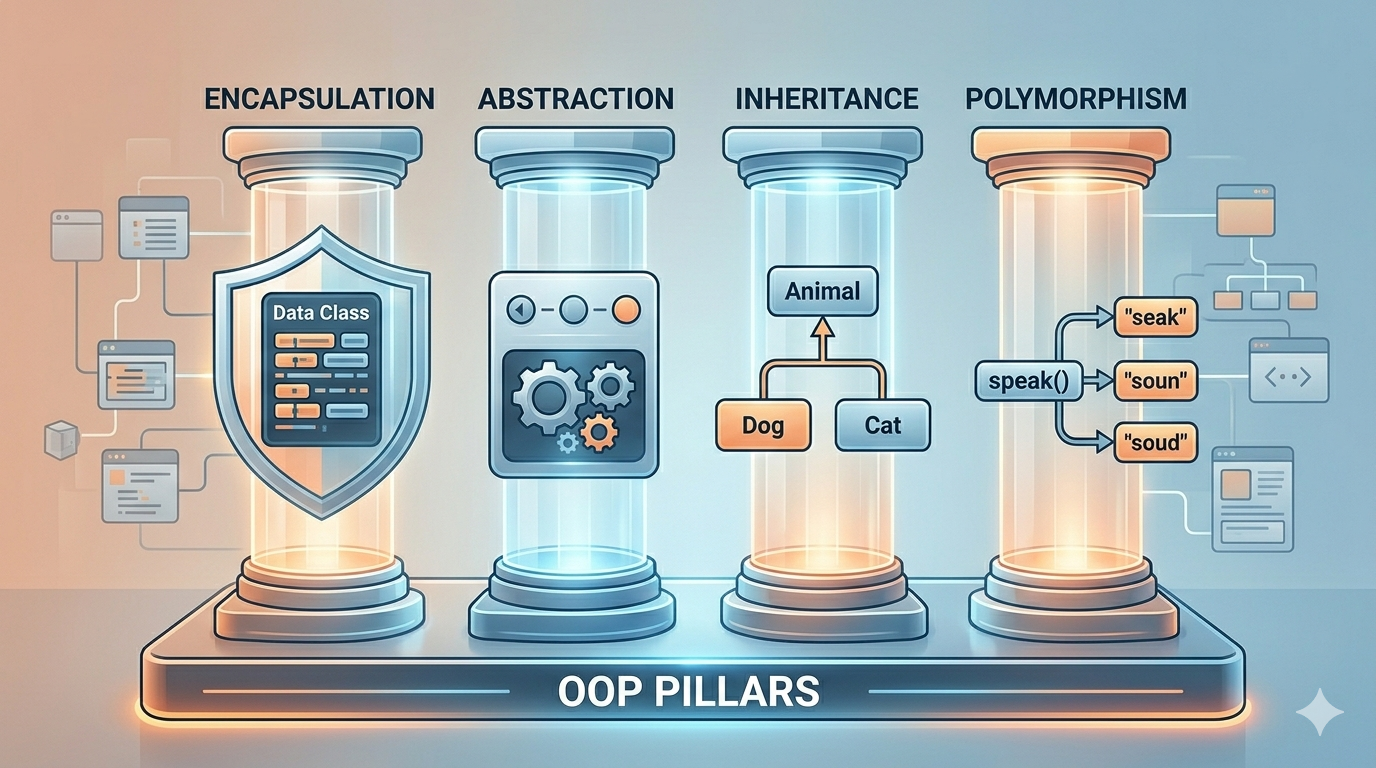
A. Abstraction: It’s about hiding complexity. When you drive a car, you press the accelerator; you don't care how the fuel injection system works. In Java, we achieve this using Abstract Classes and Interfaces.
B. Encapsulation: This is the "Protective Shield." We keep data (fields) private and provide access through public methods (getters/setters). This prevents external classes from putting "garbage" data into our objects.
C. Inheritance: This promotes Code Reusability. If a `Dog` is an `Animal`, why rewrite the `eat()` and `sleep()` methods? Just extend the `Animal` class. Remember: Java does not support Multiple Inheritance with classes to avoid the "Diamond Problem."
D. Polymorphism: One name, many forms.
• Static (Overloading): Same method name, different parameters in the same class.
• Dynamic (Overriding): Same method name and parameters, but a different implementation in a subclass.
Comprehensive Interview Q&A Bank
Q1: What is the 'static' keyword in Java?
Ans: The `static` keyword means that the variable or method belongs to the class rather than a specific instance (object). If you have a static variable `count`, all objects of that class share the exact same `count`. Static methods can be called without creating an object. This is why the `main` method is static—the JVM needs to call it before any objects exist.
Q2: What is a Constructor? Can it be inherited?
Ans: A constructor is a special block of code used to initialize an object. It has the same name as the class and no return type. Constructors are not inherited. However, when you create a child class object, the parent class constructor is always called first using the implicit `super()` call.
Q3: Explain the 'final' keyword.
Ans: The `final` keyword has three uses:
1. Final Variable: Creates a constant (value cannot change).
2. Final Method: Cannot be overridden by subclasses.
3. Final Class: Cannot be inherited (e.g., the `String` class is final).
Q4: What is the difference between '==' and '.equals()'?
Ans: This is a classic! `==` is an operator that compares memory addresses (reference equality). The `.equals()` is a method used to compare the content or state of the objects (logical equality). For example, two different String objects can have the value "Hello"—`==` will return false, but `.equals()` will return true.
Q5: What is the 'this' keyword?
Ans: `this` is a reference variable that points to the current object. It is commonly used to resolve ambiguity between instance variables and parameters with the same name, or to pass the current object as an argument to other methods.
Q6: What is an Interface? How is it different from an Abstract Class?
Ans: An interface is a blueprint of a class that only contains static constants and abstract methods (before Java 8). An abstract class can have both abstract and concrete methods. A class can implement multiple interfaces but can extend only one abstract class. Interfaces define "what a class can do" (capabilities), while abstract classes define "what a class is" (identity).
Q7: What is Exception Handling?
Ans: It is a mechanism to handle runtime errors (like `ArithmeticException` or `IOException`) so that the normal flow of the application is maintained. We use `try`, `catch`, `finally`, `throw`, and `throws`. The `finally` block is unique because it executes regardless of whether an exception occurred, making it perfect for closing file streams or database connections.
Q8: What is a Wrapper Class?
Ans: Wrapper classes (like `Integer`, `Double`, `Character`) provide a way to use primitive data types as objects. This is necessary when working with **Collections** (like `ArrayList`) because collections only store objects, not primitives.
Q9: What is Autoboxing and Unboxing?
Ans: Autoboxing is the automatic conversion the Java compiler makes between primitives and their corresponding wrapper classes (e.g., `int` to `Integer`). Unboxing is the reverse process. This feature, introduced in Java 5, makes the code much cleaner.
Q10: What are Access Modifiers?
Ans: They control the visibility of classes, methods, and variables:
• Private: Visible only within the same class.
• Default: Visible only within the same package.
• Protected: Visible within the same package and subclasses.
• Public: Visible everywhere.
Q11: Can we override a static method?
Ans: No. Static methods are bound to the class at compile time (Method Hiding), whereas overriding happens at runtime based on the object type. If you declare the same static method in a child class, it's called Method Hiding, not Overriding.
Q12: What is the 'super' keyword?
Ans: `super` is a reference variable used to refer to the immediate parent class object. It is used to call parent class methods, access parent class constructors, or access parent class variables if they are hidden by the child class.
Q13: What is the purpose of the Garbage Collector (GC)?
Ans: The GC is a background process that automatically identifies and deletes objects that are no longer reachable in the code. This prevents Memory Leaks. Unlike C++, where you must manually use `free()` or `delete`, Java handles this for you.
Q14: What is a Package in Java?
Ans: A package is a way to group related classes and interfaces. It prevents naming conflicts and makes the code easier to manage. For example, `java.util` contains utility classes, while `java.io` handles input and output.
Q15: What is the 'instanceof' operator?
Ans: It is a comparison operator used to check whether an object is an instance of a specific class or interface. It returns a boolean value.
Q16: Why is the String class immutable?
Ans: String immutability is key for:
1. Security: Parameters like usernames/passwords cannot be changed by another thread.
2. Caching: The String Constant Pool saves memory by reusing same-value strings.
3. Thread Safety: Since strings cannot change, they are safe to share across threads without synchronization.
Q17: What is the difference between 'throw' and 'throws'?
Ans: `throw` is used to explicitly throw an exception within a method. `throws` is used in the method signature to declare that this method might throw an exception, passing the responsibility to the caller method.
Q18: What is the difference between an Array and an ArrayList?
Ans: An Array has a fixed size and can store both primitives and objects. An ArrayList is a dynamic array that grows automatically but can only store objects (using wrapper classes for primitives).
Q19: What is Method Overloading?
Ans: Defining multiple methods in the same class with the same name but different parameters (change in number of args, type of args, or sequence of args). It increases program readability.
Q20: What is the base class for all Java classes?
Ans: The `java.lang.Object` class. Every class you create implicitly extends `Object` if it doesn't extend any other class. This is why every object has methods like `toString()`, `hashCode()`, and `equals()`.
6. Thinking in Java: Code Logic Examples
An interviewer might ask you to explain a snippet or find an error. Let’s look at Constructor Chaining.
Parent() {
System.out.println("Parent Constructor called");
}
}
class Child extends Parent {
Child() {
// super() is called implicitly here
System.out.println("Child Constructor called");
}
}
When you run `new Child();`, the output will be:
1. Parent Constructor called
2. Child Constructor called
Logic: Object initialization always flows from the top of the inheritance tree downwards.
7. Staying Current: Java 17, 21, and Beyond
To stand out, you must show that you aren't stuck in Java 8. Modern Java has introduced incredible features:
Records (Java 14+): A quick way to create "Data Carrier" classes without writing boilerplate code like getters, setters, or `toString()`.
Example: `record User(String name, int id) {}`
Sealed Classes (Java 17): Allows a class to restrict which other classes can extend it. This provides better control over inheritance hierarchies.
Virtual Threads (Project Loom - Java 21): This is a game-changer for high-concurrency applications. Virtual threads are lightweight threads that allow an application to handle millions of tasks with very little memory overhead compared to traditional platform threads.
How to Crack the Technical Round?
1. Don't Memorize: Understand the internal working of HashMaps, the lifecycle of a Thread, and how the GC works.
2. Be Precise: Use technical terms correctly. Don't say "hiding stuff," say "Encapsulation."
3. Connect to Real World: When explaining Abstraction, use the "Car" or "ATM" example. It shows you can apply code to reality.
4. Practice Coding: No matter how much theory you know, you must be able to reverse a String or find a duplicate in an Array without using a library.
"Java is not just a language; it is an ecosystem. Master the basics, and the rest will follow."