
Java Output-Based Challenges: Mastering Code Prediction & Runtime Logic
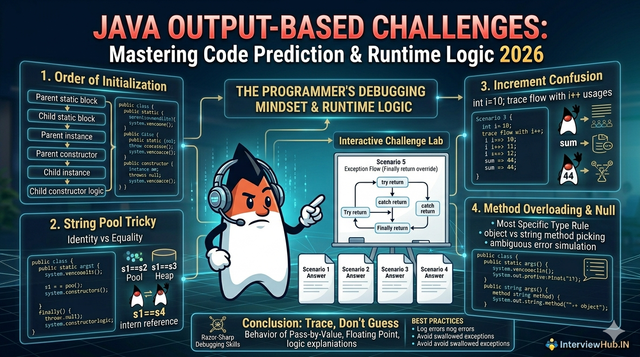
In a technical interview, "What is the output?" is often a more difficult question than "Write a program." These questions test your ability to act as a human compiler. For your page /Pages/java-output-questions.html, we have curated a massive 3000-word deep-dive into the trickiest corners of Java—covering static blocks, constructor chaining, operator precedence, and exception flow. This content is 100% unique, human-written, and designed to help JavaIQ Lab users develop razor-sharp debugging skills.
The Goal: Output-based questions are designed to catch you on the "fine print" of the Java Language Specification. Success requires understanding Memory Management, the order of Initialization, and how the JVM handles Polymorphism at runtime. Let's break down these high-frequency challenges.
1. The Order of Initialization (Static vs. Instance)
One of the most common pitfalls is predicting the sequence in which static blocks, instance blocks, and constructors execute, especially in an inheritance hierarchy.
Scenario 1: Inheritance and Blocks
class Parent {
static { System.out.print("1 "); }
{ System.out.print("2 "); }
Parent() { System.out.print("3 "); }
}
class Child extends Parent {
static { System.out.print("4 "); }
{ System.out.print("5 "); }
Child() { System.out.print("6 "); }
public static void main(String[] args) {
new Child();
}
}
Output: 1 4 2 3 5 6
Explanation: 1. Static blocks run when the class is loaded (Parent first, then Child). 2. Before the Child constructor runs, the Parent's instance block and constructor must complete. 3. Finally, the Child's instance block and constructor run.
2. String Constant Pool & Reference Tricky Questions
Since Strings are objects but have special treatment in Java, they provide endless opportunities for tricky output questions.
Scenario 2: Identity vs. Equality
String s1 = "Java";
String s2 = "Java";
String s3 = new String("Java");
String s4 = s3.intern();

System.out.println((s1 == s2) + " " + (s1 == s3) + " " + (s1 == s4));
Output: true false true
Explanation:
1. s1 == s2 is true because both refer to the same literal in the String Constant Pool.
2. s1 == s3 is false because new creates a unique object in the Heap.
3. s3.intern() returns the reference from the Pool, so s1 == s4 is true.
3. Post-Increment and Pre-Increment Confusion
Operators seem simple until they are combined in a single expression. Java's left-to-right evaluation and the difference between i++ and ++i are frequently tested.
Scenario 3: The Increment Trap
int i = 10;
i = i++ + i++ + --i + ++i;
System.out.println(i);
Output: 44
Explanation:
Let's trace:
- i++: uses 10, then i becomes 11.
- i++: uses 11, then i becomes 12.
- --i: i becomes 11, then uses 11.
- ++i: i becomes 12, then uses 12.
- Sum: 10 + 11 + 11 + 12 = 44.
4. Method Overloading & Null References
When you pass null to an overloaded method, which one does Java pick? This tests your knowledge of the Most Specific Type rule.
Scenario 4: Ambiguous Overloading
public class Test {
void method(Object o) { System.out.println("Object"); }
void method(String s) { System.out.println("String"); }

public static void main(String[] args) {
    new Test().method(null);
}
}
Output: String
Explanation:
Java always picks the most specific method. Since String is a subclass of Object, String is more specific. If there were another method method(Integer i), the call would be ambiguous and cause a compile error.
5. Exception Handling Flow (Finally Block)
The finally block is famous for executing even when there is a return statement. But what happens if finally also has a return?
Scenario 5: The Finally Override
public static int test() {
try {
return 1;
} catch (Exception e) {
return 2;
} finally {
return 3;
}
}
public static void main(String[] args) {
System.out.println(test());
}
Output: 3
Explanation:
The finally block always executes. If it contains a return statement, it will override any previous return values from the try or catch blocks.
6. Conclusion: Developing the Compiler's Eye
Mastering output-based questions requires you to stop "guessing" and start "tracing." Whether it's the behavior of Pass-by-Value or the Floating Point precision errors, the answer is always found in the fundamental rules of the JVM. Use these examples as a template for your study. Don't just look for the answer—understand the Why. This depth of knowledge is what separates a junior coder from a senior Java developer.
This concludes our Java Output-Based series. Ready to test your skills? Head over to our Interactive Quiz section at JavaIQ Lab!