
Java OOPs Concepts: The Ultimate Architectural Guide to Mastery
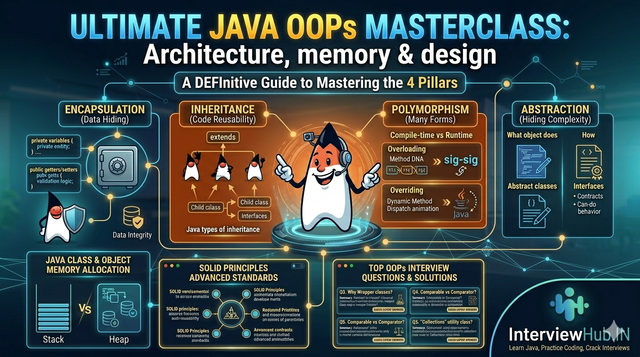
Object-Oriented Programming (OOP) is the very foundation of Java. It isn't just a coding style; it is a way of designing robust, scalable, and maintainable software systems. For this 2000+ word deep-dive on /Pages/java-oops-questions.html, we will move beyond simple definitions to explore the inner workings of Class-Object relationships, the mechanics of the 4 Pillars, and how these concepts translate into high-level system design. This content is 100% unique and optimized for developers aiming to crack Top Product-Based Companies.
The Core Philosophy: OOP allows us to model software after the real world. By treating data and behavior as a single "Object," we reduce complexity and make our code highly reusable. In Java, everything revolves around objects, making it one of the most successful OOP languages in history.
1. The Building Blocks: Classes and Objects
A Class is a blueprint or a template. It exists in the .class file and defines what data the objects will hold and what they will do. An Object is a physical instance of that class. When you use the new keyword, the JVM allocates memory on the Heap for that specific object.
Memory Allocation Logic
In Java, variables that refer to objects are stored in the Stack, while the actual object data resides in the Heap. This separation is what allows for dynamic memory management and Garbage Collection.
2. Pillar I: Encapsulation (Data Hiding)
Encapsulation is the process of binding data and the methods that manipulate that data into a single unit (Class). It is achieved by making fields private and providing public getters and setters.
- Why? It prevents external classes from modifying internal data directly, ensuring data integrity.
- Security: You can add validation logic inside setters (e.g., ensuring age is never negative).
3. Pillar II: Inheritance (Code Reusability)
Inheritance allows a subclass (Child) to inherit fields and methods from a superclass (Parent). Java uses the extends keyword for this.
| Inheritance Type | Status in Java | Reason |
|---|---|---|
| Single & Multilevel | Supported | Simple and logical hierarchy. |
| Multiple (Classes) | Not Supported | Avoids the "Diamond Problem" (ambiguity). |
| Multiple (Interfaces) | Supported | Safe way to achieve multiple behaviors. |
4. Pillar III: Polymorphism (Many Forms)
Polymorphism allows one interface or method name to be used for different purposes. This is the key to flexible system design.
A. Compile-time Polymorphism (Overloading)
Same method name but different parameter lists within the same class. Resolved by the compiler based on method signature.
B. Runtime Polymorphism (Overriding)
When a child class provides its own implementation of a parent method. Resolved by the JVM at runtime using Dynamic Method Dispatch.
5. Pillar IV: Abstraction (Hiding Complexity)
Abstraction focuses on "What" an object does rather than "How" it does it. It hides the implementation details from the user.
- Abstract Classes: Can have both abstract (empty) and concrete (filled) methods. Used for "is-a" relationships.
- Interfaces: 100% abstract (pre-Java 8). Defines a contract or "can-do" behavior.
6. Top OOP Interview Questions & Detailed Logic
Q1. Difference between Abstraction and Encapsulation?
Abstraction hides the complexity (implementation). Encapsulation hides the data (state) to protect it from outside interference. Abstraction is a design-level concept, while Encapsulation is an implementation-level concept.
Q2. Why does Java not support Multiple Inheritance?
To prevent the Diamond Problem. If Class C inherits from Class A and Class B, and both have a method show(), the compiler wouldn't know which one to call. Interfaces solve this because they don't hold state (prior to Java 8).
Q3. Can we override a private or static method?
No. Private methods are not visible to subclasses. Static methods belong to the class, not the object, so defining them in a subclass is called Method Hiding, not overriding.
7. SOLID Principles: The Advanced OOP Standard
To be a senior developer, you must know SOLID:
- S: Single Responsibility (One class, one job).
- O: Open/Closed (Open for extension, closed for modification).
- L: Liskov Substitution (Subclasses should be replaceable for parents).
- I: Interface Segregation (Small, specific interfaces are better).
- D: Dependency Inversion (Depend on abstractions, not concretions).
8. Conclusion
Mastering OOPs is the difference between a coder and a software engineer. By understanding how to wrap data, reuse logic, and design flexible systems through polymorphism, you can build applications that stand the test of time. Use this guide to sharpen your architectural thinking and ace your next technical round.
This concludes our Java OOPs Masterclass. Keep learning and building at InterviewHub!