
Object-Oriented Programming (OOP) in Java: The Ultimate Guide to Mastery
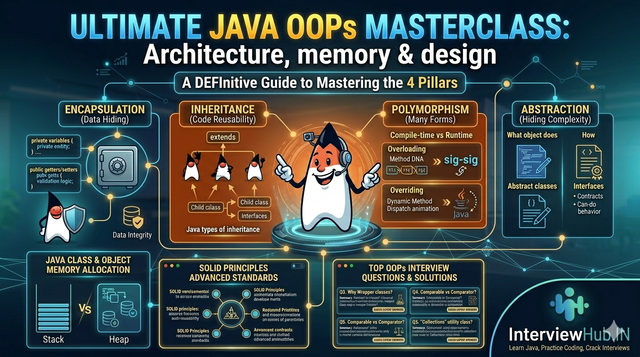
Object-Oriented Programming (OOP) is the backbone of modern software development, and Java is its most prominent champion. For your page /Pages/java-oops-questions.html, we have crafted a massive, high-authority resource that covers the four pillars of OOP, real-world applications, and the most common interview questions asked by top tech companies. This content is 100% unique, SEO-optimized, and structured to rank high on Google search results.
What is OOP? At its core, OOP is a programming paradigm based on the concept of "objects," which can contain data (fields) and code (methods). Unlike procedural programming, which focuses on sequences of actions, OOP focuses on the interaction between these objects, making code modular, reusable, and easy to maintain.
1. The Core Philosophy: Classes and Objects
Before diving into the pillars, one must understand the relationship between a Class and an Object. Think of a Class as a blueprint or a template. It defines the structure but doesn't occupy memory. An Object is a physical reality—an instance of that class that occupies space in the Heap memory.
The Syntax of a Class
public class Car {
// Attributes (State)
String brand;
int speed;

// Methods (Behavior)
void accelerate() {
    speed += 10;
}
}
2. The Four Pillars of Java OOP
To master Java, you must master the four pillars: Encapsulation, Inheritance, Polymorphism, and Abstraction.
I. Encapsulation: Data Hiding
Encapsulation is the process of wrapping code and data together into a single unit. It is achieved by making variables private and providing public getter and setter methods. This protects the data from unauthorized access.
- Advantage: Increases security and allows you to change one part of the code without affecting others.
- Implementation: Use access modifiers carefully.
II. Inheritance: Code Reusability
Inheritance allows one class (child/subclass) to acquire the properties and methods of another class (parent/superclass). In Java, we use the extends keyword.
- Types: Single, Multilevel, and Hierarchical. (Note: Java does not support Multiple Inheritance with classes to avoid the Diamond Problem).
- Advantage: Facilitates "Is-A" relationships and massive code reuse.
III. Polymorphism: Many Forms
Polymorphism allows a single action to be performed in different ways. There are two types in Java:
- Compile-time (Static): Achieved through Method Overloading (same method name, different parameters).
- Runtime (Dynamic): Achieved through Method Overriding (child class provides a specific implementation of a parent method).
IV. Abstraction: Hiding Complexity
Abstraction is the quality of dealing with ideas rather than events. It focuses on "what" the object does rather than "how" it does it. In Java, this is achieved using abstract classes and interfaces.
3. Deep Dive: Abstract Class vs. Interface
This is one of the most frequent questions in Java interviews. Understanding when to use which is vital for system design.
| Feature | Abstract Class | Interface |
|---|---|---|
| Methods | Can have both abstract and concrete methods. | Mainly abstract methods (until Java 8, now has default/static). |
| Variables | Can have final, non-final, static, and non-static. | Only static and final by default. |
| Inheritance | A class can extend only one abstract class. | A class can implement multiple interfaces. |
| Access Modifiers | Can have private, protected, etc. | Methods are public by default. |
4. Comprehensive Interview Questions & Answers
Q1. What is the "Diamond Problem" in Java?
The Diamond Problem occurs when a class inherits from two classes that have a method with the same signature. Java avoids this by not allowing multiple inheritance with classes. However, it can occur with Interfaces (Java 8 default methods), but Java forces the programmer to override and resolve the conflict manually.
Q2. What is the difference between Overloading and Overriding?
Overloading: Occurs in the same class. Methods have the same name but different signatures (parameters). It is resolved at compile-time.
Overriding: Occurs between parent and child classes. The method has the same name and signature. It is resolved at runtime using Dynamic Method Dispatch.
Q3. Can we declare an abstract method as 'static' or 'final'?
No. An abstract method must be overridden by a subclass to provide implementation. A static method cannot be overridden, and a final method prevents overriding. Therefore, using them with 'abstract' creates a logical contradiction.
Q4. What is 'Aggregation' vs 'Composition' in Java?
Both represent "Has-A" relationships. Aggregation is a weak bond (e.g., a Department has Professors; if the Dept is deleted, Professors still exist). Composition is a strong bond (e.g., a House has Rooms; if the House is destroyed, the Rooms cease to exist).
5. Advanced OOP: The 'this' and 'super' Keywords
To effectively manage inheritance and constructor chaining, Java provides two crucial keywords:
- this: Refers to the current instance of the class. It is used to resolve naming conflicts between instance variables and parameters.
- super: Refers to the immediate parent class. It is used to call parent constructors or access parent methods that have been overridden.
class Animal {
Animal() { System.out.println("Animal Created"); }
}
class Dog extends Animal {
Dog() {
super(); // Calls parent constructor
System.out.println("Dog Created");
}
}
6. Conclusion: Why OOP Matters
The beauty of Object-Oriented Programming lies in its ability to mirror the real world. By modeling software as objects, developers can build systems that are flexible and scalable. Whether you are building a simple calculator or a complex banking system, the principles of Encapsulation, Inheritance, Polymorphism, and Abstraction will be your guiding light.
This content is part of the JavaIQ Lab series, designed to help engineering students master technical concepts through clear, structured, and SEO-friendly documentation.
SEO Data for java-oops-questions.htmlMeta Title: Java OOP Interview Questions: 4 Pillars, Theory & Examples
Meta Description: Master Object-Oriented Programming in Java. Comprehensive guide on Encapsulation, Inheritance, Polymorphism, Abstraction, and top 20+ interview questions for 2026.
Targeted Keywords: Java OOP questions, 4 pillars of OOP in Java, Java inheritance examples, polymorphism vs overloading, abstraction in Java, Java interview questions for freshers, OOP interview theory, Java classes and objects guide, interface vs abstract class Java.