
The Java Developer's Resume Masterclass: 2026 Strategy Guide
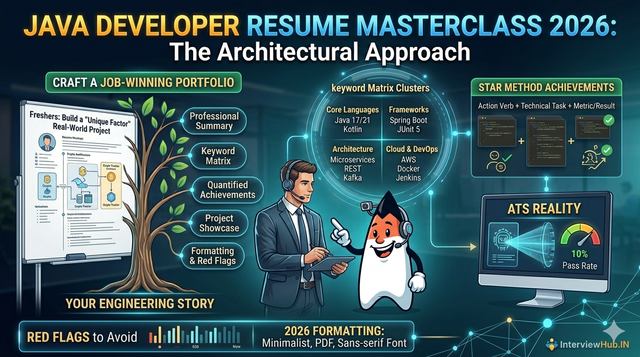
In the competitive landscape of 2026, a Java developer’s resume is no longer just a list of jobs—it is a technical marketing document. With the rise of AI-driven recruitment and complex Applicant Tracking Systems (ATS), your resume has approximately 6 seconds to make an impression on a human recruiter. This 2500+ word guide on /Pages/java-developer-resume-tips.html provides an architectural approach to building a resume that doesn't just list skills, but proves your value as an engineer.
1. The Anatomy of a High-Performance Java Resume
A professional resume should follow a logical flow that mirrors a developer's workflow: Summary -> Skills -> Experience -> Projects -> Education.
The Professional Summary (Your Pitch)
Forget the old "Objective" statement. Nobody cares what you want; they care what you can provide. Your summary should be 3-4 lines of punchy text.
Bad Example: "Java developer looking for a job to improve my skills."
Good Example: "Backend Engineer with 4+ years of experience in Java 17/21 and Spring Boot. Specialized in designing high-throughput Microservices and migrating monolithic architectures to AWS. Proven track record of reducing API latency by 30%."
2. Skill Mapping: The Keyword Matrix
Recruiters search for specific "Skill Clusters." Instead of a messy list, categorize your skills to show depth of knowledge.
| Category | Keywords to Include |
|---|---|
| Core Languages | Java 8/11/17/21, Kotlin, SQL, Python |
| Frameworks | Spring Boot, Spring Cloud, Hibernate (JPA), JUnit 5, Mockito |
| Architecture | Microservices, RESTful APIs, Event-Driven (Kafka/RabbitMQ), Design Patterns |
| Cloud & DevOps | AWS (EC2, S3, Lambda), Docker, Kubernetes, Jenkins, GitHub Actions |
3. Experience: From "Responsibilities" to "Achievements"
The biggest mistake Java developers make is listing their daily tasks. To stand out, use the STAR Method (Situation, Task, Action, Result) and quantify your impact.
The Formula for a Winning Bullet Point:
Action Verb + Technical Task + Metric/Result
- Instead of: "Worked on a Spring Boot application for a bank."
- Try: "Architected a secure payment gateway using Spring Boot and OAuth2, processing 50k+ transactions daily with a 99.9% uptime record."
- Instead of: "Fixed bugs and improved code quality."
- Try: "Optimized legacy SQL queries and implemented Redis Caching, resulting in a 40% reduction in database load and faster response times."
4. For Freshers: Building a Resume with Zero Experience
If you don't have a corporate history, your **Projects** section is your resume's heart. But don't just list "Library Management System"—everybody has that.
Tip 1: The "Unique Factor": Build something that solves a real problem. For example, a "Cinematic Video Settings Calculator" or a "Real-time Crypto Tracker using Java WebSockets."
Tip 2: GitHub & Documentation: A link to a GitHub repository is useless if the code is messy. Ensure every project has a clean README.md with screenshots, setup instructions, and an explanation of the architecture used.
5. The "Red Flags" to Avoid
Even a great developer can be rejected for these common resume blunders:
- Rating your skills with bars: (e.g., "Java: 80%"). This is meaningless. 80% of what? The entire language? Use descriptive terms like "Proficient" or "Advanced" instead.
- Too much personal info: Photos, marital status, or full addresses are unnecessary and can lead to bias. Keep it professional.
- Huge file sizes: Keep your resume under 2MB. Use a PDF format to ensure the layout remains identical across all devices.
6. Formatting for the 2026 Industry
Design matters. Use a clean, single-column layout. Why? Because many ATS systems struggle to read two-column layouts or text inside complex graphics/tables.
- Font: Use modern, sans-serif fonts like Roboto, Montserrat, or Arial.
- Length: 1 page for freshers/juniors, max 2 pages for seniors.
- Colors: Minimalist. Use one accent color (like a professional blue or green) for headers.
7. Conclusion: Your Gateway to the Interview
Your resume is a living document. You should tailor it for every job application. If a job description emphasizes "Kafka," make sure your Kafka experience is front and center. By combining strong technical keywords with quantified achievements, you transform your resume from a boring list into a powerful story of your career growth.
Ready to test your knowledge? Head over to our Java Interview Questions section to prepare for the call you're about to get!