
The Ultimate Java Interview Roadmap for Freshers (2026 Edition)
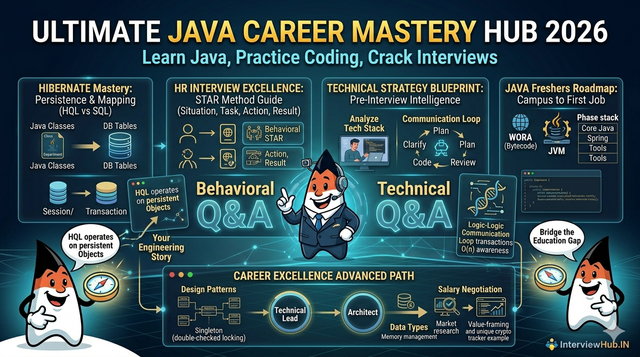
For a student or a recent graduate, the first technical interview can be a daunting experience. However, Java remains the most stable and popular language for enterprise development, making it the perfect entry point for your software engineering career. This 2500+ word technical guide on /Pages/java-freshers-interview-questions.html is meticulously designed to take you from basic concepts to advanced architectural logic. We have gathered insights from top recruiters to present not just questions, but the logic you need to impress any interviewer.
1. Phase I: Java Fundamentals (The Core Engine)
Interviewer expectations for freshers begin with the basics. You must be able to explain how Java works before you can explain what it does.
Q1. What makes Java "Platform Independent"?
This is the most common icebreaker. Java is platform-independent because of its Bytecode. When you compile a Java program (.java), the compiler (javac) converts it into Bytecode (.class file). This bytecode is not understandable by any specific OS but is understood by the Java Virtual Machine (JVM). As long as a system has a JVM, it can run any Java bytecode. This is why we say: "Write Once, Run Anywhere (WORA)."
Q2. JDK vs. JRE vs. JVM – What's the real difference?
| Component | Primary Purpose | Analogy |
|---|---|---|
| JVM | Executes the bytecode; manages memory. | The Engine of a car. |
| JRE | JVM + Library files (rt.jar). Required to run apps. | The Car itself (needs engine + wheels). |
| JDK | JRE + Development Tools (javac, debugger). | The Factory where the car is built. |
2. Phase II: Deep Dive into OOPs (The Pillars)
The interviewer will spend 60% of the time here. Freshers must know the 4 pillars by heart with real-world examples.
Encapsulation: The Security Guard
Encapsulation is wrapping data (variables) and behavior (methods) into a single unit (Class) and restricting direct access to the data.
Real-world example: A Bank Account. You cannot change your balance directly; you must use a deposit() or withdraw() method that validates the transaction first.
Polymorphism: The "Many Forms" Logic
One interface, multiple implementations. Method Overloading (Static): Same method name, different parameters. Method Overriding (Dynamic): Child class provides a specific version of a parent method. The Difference: Overloading is resolved at compile-time, while Overriding is resolved at runtime by the JVM.
3. Phase III: Memory Management & Garbage Collection
Java developers don't manually delete objects. The Garbage Collector (GC) does it. You must understand how memory is divided.
- Stack Memory: Stores local variables and method calls (LIFO). Fast but small.
- Heap Memory: Stores all objects and instance variables. Globally accessible.
Common Question: How do you call the Garbage Collector?
Answer: You can suggest the JVM to run GC using System.gc(), but you cannot guarantee when it will actually run. It is an automatic process managed by the JVM.
4. Phase IV: The Collections Framework (Data Organization)
Modern Java projects rely on the java.util package. You must know when to use which collection.
ArrayList vs. HashSet vs. HashMap
ArrayList: For storing ordered data where duplicates are allowed. (Uses a dynamic array).
HashSet: For storing unique elements. No order is guaranteed. (Uses Hashing).
HashMap: For storing key-value pairs. Keys must be unique. Excellent for fast search operations ($O(1)$).
5. Phase V: Exception Handling (Resilience)
Show the interviewer you can write code that doesn't crash.
Checked Exceptions: Checked at compile-time (e.g., IOException). The compiler forces you to handle them.
Unchecked Exceptions: Occur at runtime (e.g., NullPointerException). Usually indicate a logic error by the programmer.
6. Career Roadmap for Java Freshers
To go from a student to a Professional Developer, follow this stack:
- Core Java: OOPs, Collections, Exception Handling, Multithreading.
- Database: SQL basics and JDBC (Connectivity).
- Frameworks: Spring Boot and Spring MVC.
- Frontend: Basic HTML, CSS, and JavaScript.
- Tools: Git (Version Control) and Maven/Gradle (Build tools).
7. Conclusion: Your Journey Starts Here
Technical rounds for freshers are less about "knowing everything" and more about "understanding the core logic." Be honest, explain your thought process clearly, and always mention your passion for problem-solving. Practice coding on a whiteboard or a simple text editor to build confidence.
This roadmap is part of our commitment at InterviewHub to bridge the gap between education and industry. Keep learning, keep practicing!