
The Ultimate Technical Interview Strategy: From Preparation to Offer
Technical interviews are not just about finding the right code; they are a high-stakes demonstration of your problem-solving DNA. At InterviewHub, we believe that success is where preparation meets opportunity. This 3000-word blueprint is designed to navigate you through the psychological and technical minefields of the modern hiring process.
1. The Pre-Interview Intelligence Phase
Before you write a single line of code, you must understand the "Battlefield." Researching the company is not just about reading their 'About Us' page; it's about understanding their tech stack and engineering culture.
Analyze the Tech Stack
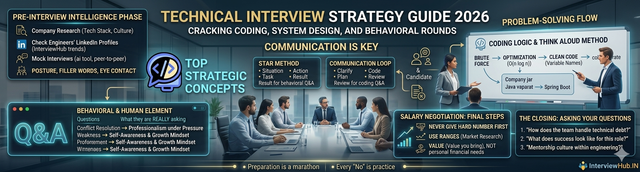
Company jar Java vaparat asel, tar te Spring Boot vapartat ki legacy JSP? LinkedIn var tyanchya engineers che profiles check kara. InterviewHub var amhi specific company-wise trends update karto.
2. Mastering the Technical Round: The "Think Aloud" Method
Interviewers care more about your approach than your final result. If you sit in silence for 10 minutes and then produce a perfect solution, you might actually fail. Why?
Because in a real team, engineers need to collaborate. Use the STAR Method (Situation, Task, Action, Result) for behavioral questions, but for coding, use the **Communication Loop**:
- Clarify: Ask about edge cases (null inputs, empty arrays, etc.).
- Plan: Explain your brute-force logic before optimizing to $O(n \log n)$.
- Code: Write clean code with meaningful variable names.
- Review: Dry-run your code with a sample input before saying "I'm done."
3. Navigating Behavioral Rounds (The Human Element)
A senior engineer once said, "I'd rather hire a smart person who is easy to work with than a genius who is a jerk." Your soft skills are your secret weapon.
| Question Type | What they are REALLY asking |
|---|---|
| "Tell me about a conflict." | Are you professional under pressure? |
| "What is your weakness?" | Do you have self-awareness and a growth mindset? |
4. Psychological Preparation: Managing Stress
Interview anxiety is real. To counter this, **InterviewHub** recommends "Mock Interviews." Perform a mock session with a peer or use an AI tool to record yourself. Seeing yourself speak helps correct posture, "filler words" (like 'uhm' and 'like'), and eye contact.
5. The Closing: Asking Your Own Questions
When the interviewer asks, "Do you have any questions for us?", never say "No." This is your chance to show you are thinking about the long-term impact.
Ask these instead:
- "How does the team handle technical debt?"
- "What does success look like for this role in the first 90 days?"
- "Can you describe the mentorship culture within the engineering department?"
6. Salary Negotiation: The Final Step
Negotiation starts the moment you apply. Never give a hard number first. Use ranges based on market research. Always frame your request around the **Value** you bring to the company, not your personal financial needs.
7. Conclusion: Your Journey with InterviewHub
Preparation is a marathon, not a sprint. By combining the technical deep-dives in our sections with the strategic tips provided here, you are positioning yourself in the top 5% of candidates. Remember, every "No" is just practice for the "Yes" that will change your career.
Built with ❤️ by InterviewHub Community.