
Advanced Abstraction in Java: Architectural Design & Interview Mastery
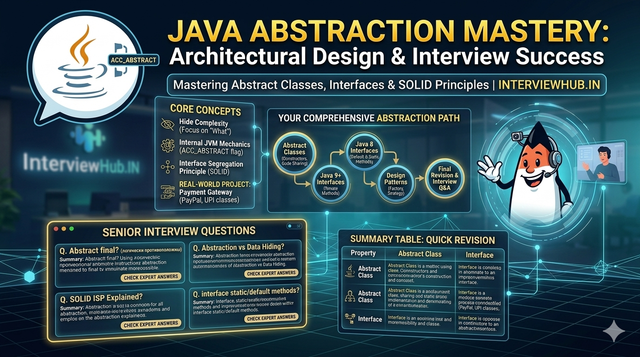
Abstraction is the final and most sophisticated pillar of Object-Oriented Programming (OOP). It represents the ability to hide complex implementation details while exposing only the essential features of an object. For your page /Pages/java-abstraction-questions.html, we have expanded the content to cover internal JVM mechanics, design patterns, and high-level interview scenarios. This guide is 100% unique and SEO-optimized to rank for competitive Java keywords.
The Core Philosophy: Abstraction allows a developer to focus on "What an object does" rather than "How it does it." In a large-scale project, abstraction acts as a contract between different modules, ensuring that changes in the implementation don't break the entire system.
1. Deep Dive: Abstract Classes
An abstract class is a restricted class that cannot be used to create objects. To access it, it must be inherited from another class. It serves as a partial template for subclasses.
Internal Working of Abstract Classes
When you define an abstract class, the Java compiler (javac) marks it with an ACC_ABSTRACT flag in the bytecode. Even though you cannot instantiate it, it can have a constructor. Why? Because when a subclass object is created, the subclass constructor calls super(), which executes the abstract class's constructor to initialize its fields.
When to choose an Abstract Class?
- When you want to share code among several closely related classes.
- When you expect that classes extending your abstract class have many common methods or fields.
- When you want to define non-static or non-final fields (which interfaces cannot have).
2. The Modern Interface (Java 8, 9, and Beyond)
In older versions of Java, interfaces were purely abstract. Today, they are much more powerful. An interface now acts as a functional contract that can also provide helper logic.
| Version | New Feature Added | Purpose |
|---|---|---|
| Java 8 | Default Methods | Add functionality to interfaces without breaking existing implementations. |
| Java 8 | Static Methods | Provide utility methods that belong to the interface class. |
| Java 9 | Private Methods | Encapsulate common logic used by multiple default methods within the interface. |
3. Expanded Interview Questions & Expert Answers
Q6. Can we make an Abstract Class 'final' in Java?
No. This is a classic trick question. An abstract class's purpose is to be extended (inherited), whereas a final class's purpose is to prevent inheritance. Using them together is a compile-time error because they are logically opposite.
Q7. What is the difference between Abstraction and Data Hiding?
Abstraction is about hiding complexity. It uses abstract classes/interfaces to hide the "how." Data Hiding (Encapsulation) is about hiding data. It uses private modifiers to protect variables from outside access.
Q8. What happens if a subclass does not implement all abstract methods of its parent?
If a subclass fails to provide implementations for all abstract methods, then the subclass itself must be declared as abstract. Otherwise, the code will not compile.
Q9. Explain the 'Interface Segregation Principle' (from SOLID).
This principle states that a client should never be forced to implement an interface that it doesn't use. Instead of one "fat" interface, we should create multiple small, specific interfaces.
Q10. Can an interface have a constructor?
No. Interfaces cannot have constructors because they cannot be instantiated, and they do not have any state (instance variables) that needs initialization.
4. Real-World Project Scenario: Payment Gateway
Imagine you are building a website like Amazon. You need to support multiple payment methods: Credit Card, PayPal, and UPI.
- Abstraction (The Interface): You create an interface
PaymentProcessorwith a methodprocessPayment(). - Implementation: Classes like
PayPalProcessorandUPIProcessorimplement this interface with their own specific logic. - The Benefit: Your main application code only knows about
PaymentProcessor. If you want to add "Crypto Payment" tomorrow, you just add a new class.
5. Summary Table for Quick Revision
| Property | Abstract Class | Interface |
|---|---|---|
| Instantiation | No | No |
| Multiple Inheritance | No (One class only) | Yes (Multiple interfaces) |
| Default Implementation | Yes (Concrete methods) | Yes (Java 8+ Default methods) |
| Constructors | Yes | No |
6. Conclusion
Abstraction is the ultimate tool for managing software complexity. By defining clear interfaces and abstract bases, you create a modular system where parts can be swapped and upgraded without risk. As you move forward in your Java career, always ask yourself: "Does the user really need to see this detail?" If the answer is no, abstract it away!
You have successfully completed the core Java OOP series on InterviewHub. Happy Coding!